In Windermere, a "Permitted Dock" Is Only Half the Story
September 24, 2026
September 24, 2026
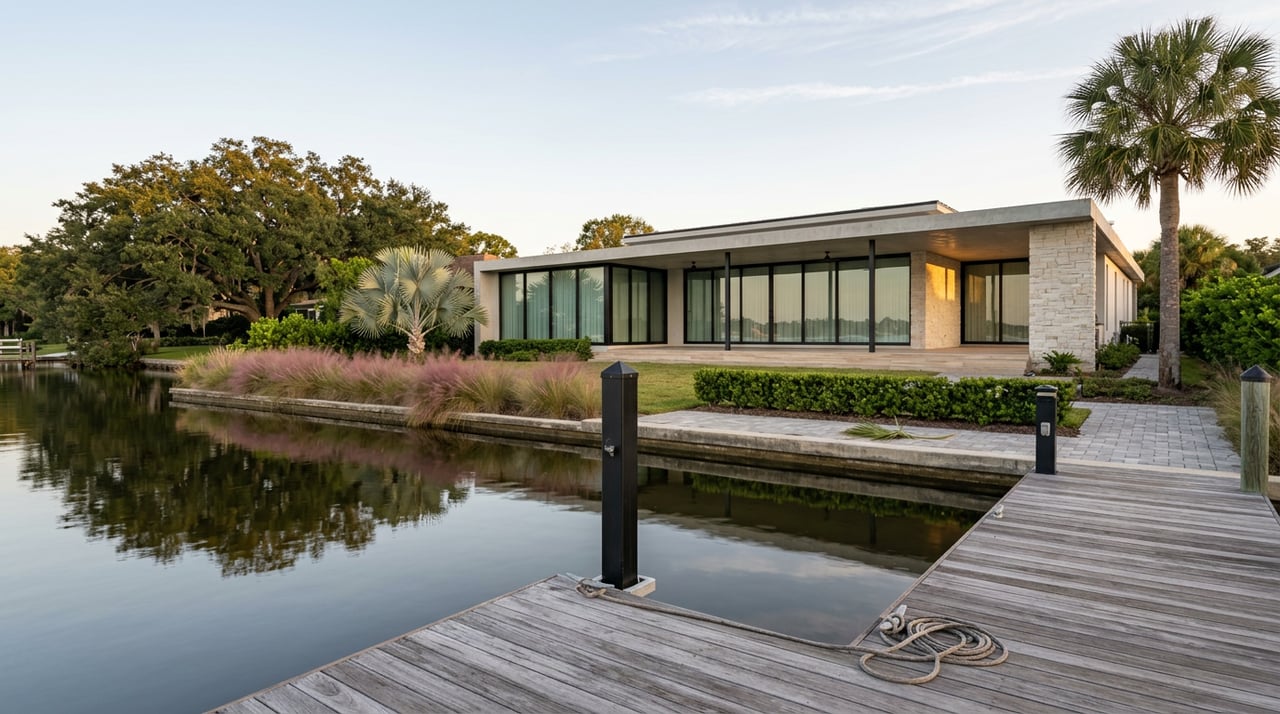
The title company usually asks the same question during closing week on a Butler Chain property: can you produce the permit number for the dock. Not a photo. Not a seller's assurance that "it's always been there." A number, tied to a state file, that someone can look up.
More often than buyers expect, the seller has a receipt for dock construction, a contractor's invoice, maybe an old county building card. What they don't have is confirmation that the St. Johns River Water Management District ever issued an Environmental Resource Permit for the structure. On a chain of lakes carrying Florida's strictest water designation, that gap is not a paperwork inconvenience. It is the difference between owning a legal amenity and inheriting someone else's unresolved compliance problem.
Here is the part that catches buyers off guard: a Butler Chain dock needs approval from two separate governments, and neither one automatically checks the other's work.
The Butler Chain was the first lake system in Florida to receive the Outstanding Florida Waters designation, granted in 1985 for its water quality and wildlife habitat. That status means any new dock, dock expansion, seawall repair, or fill and excavation work near the water triggers state-level environmental review through SJRWMD, in addition to the county approval any Florida homeowner would expect for construction.
| Permit | Issued By | Covers | Typical Timeline |
|---|---|---|---|
| Environmental Resource Permit | St. Johns River Water Management District | New dock construction, dock expansion, seawall work, fill or excavation near the lake | 60 to 120 days for standard applications, longer for larger or unusual structures |
| Building Permit | Orange County Building and Zoning Division | Structural approval for the same dock, filed independently of the state review | Varies with application completeness and volume |
A homeowner can have one of these and not the other. A dock built decades ago under a county card that predates current SJRWMD records is not automatically grandfathered just because it's old. The only way to know is to pull the actual permit number and check it against both agencies, not one.
On this chain, two clocks run at once, and only one of them shows up when you ask the seller if the dock is "permitted."
There's a rule buyers rarely hear about until they're already deep in due diligence: Orange County allows lakefront owners to maintain a vegetation-free access corridor of 30 feet or 20 percent of their shoreline frontage, whichever is greater, without needing a permit. Clear beyond that line, or remove native shoreline trees outside it, and a permit becomes necessary. A dock has to sit inside that same corridor, which means its location is set by a shoreline formula, not by wherever the view happens to be best.
The Butler Chain gets marketed as one asset. It isn't. It's eleven connected lakes, and what a dock permit actually buys you depends entirely on which lake the property touches.
Lake Tibet-Butler is the chain's premier ski lake, home to a permanent slalom course, a rarity in Central Florida. Lake Butler, the largest in the system, is open to skiing but shares the water with fishing, paddleboarding, and heavy recreational traffic, especially on summer afternoons. Lake Down is skiable too, though weekend crowding is common. Lakes Mabel, Bessie, and Chase are generally not suited to high-speed skiing during peak hours simply because of their size and boat density.
Every shoreline, dock, and swimming area on the chain sits inside a 300-foot no-wake buffer, and the narrow canals connecting the lakes, including the passage linking Lake Tibet-Butler to Lake Butler, are idle-speed only. That buffer is uniform. What isn't uniform is how much open water exists once you clear it. A buyer who assumes "Butler Chain lakefront" guarantees ski access can close on a property where the lived reality is a quiet, protected pool.
That variance shows up in price. Waterfront frontage on the chain doesn't price like square footage. It prices by the linear foot, and a 100-foot lot on an open, skiable lake is a different financial asset than a narrower lot on a quieter one, even if the house itself is identical.
A typical home inspection contingency gives a buyer ten to fifteen days to negotiate repairs. Dock permitting doesn't work on that clock. SJRWMD's standard review window alone runs 60 to 120 days, and that's before the county building permit is filed. If a dock turns out to be unpermitted, there's no fast path to resolving it before a normal closing date. The buyer either accepts the risk, negotiates a credit large enough to cover a rebuild, or walks.
This is why sophisticated sellers on the chain have started treating permit documentation as part of the listing, not an afterthought. An 11-acre Windermere estate that came to market in May 2026 for $27 million marketed deeded access and permit status as a distinct feature of the sale, not a footnote buried in disclosures. That's a meaningful shift. It tells you the market has already priced in the risk of unpermitted structures, even if any individual buyer hasn't thought to ask yet.
It also explains why non-waterfront homes in Windermere's Butler Chain-adjacent communities can still start around $650,000 as of the second quarter of 2026, while direct estate-scale lakefront, in a community like Isleworth, regularly clears $4.9 million to $9.5 million. The gap isn't just about square footage or finishes. It's about who has already done the permitting work and who hasn't.
Does every home on the Butler Chain come with the right to build a dock? Not automatically. Deeded riparian rights and shoreline access need to be confirmed in the title work, and any new dock still requires both permits regardless of whether the home is already built.
If a dock has been there for decades, is it automatically legal? Age isn't proof. The only reliable check is pulling the SJRWMD permit number and confirming the county has a matching building permit on file.
Can I clear brush along my shoreline to open up a view? Orange County allows a vegetation-free corridor of 30 feet or 20 percent of shoreline frontage, whichever is greater, without a permit. Anything beyond that line requires one, and any dock has to sit inside that same corridor.
The Butler Chain rewards patience during due diligence in a way most Florida waterfront doesn't ask for. Two agencies, one shoreline rule, and eleven lakes that don't behave the same way once you're past the no-wake buffer. Buyers and sellers who treat that as part of the deal, not a formality after it, are the ones who close without surprises.
If you're weighing a Butler Chain property, whether as a primary residence or as part of a longer-term investment plan, Marcelo Teixeira and the Glasstone team can walk through permit verification, lake-specific access, and pricing context before you go hard on a contract. Receive Exclusive Listings by reaching out directly.